Introduction
As we approach 2026, the Year of the Horse (马年 - Mǎ nián), HSK learners have the perfect opportunity to align their study with the calendar. In Chinese culture, the horse represents speed, energy, and success.
Understanding the horse is about more than just animal vocabulary; it connects you to dozens of historical idioms (Chengyu) that appear frequently in HSK 5 and 6 reading passages. Whether you are preparing for an exam or just want to wish your colleagues luck, this guide covers the essential equine terminology.
Essential Horse Vocabulary by Level
The Basics (HSK 1-3)
- 马 (Mǎ) - Horse.
- 骑马 (Qí mǎ) - To ride a horse (Verb + Object).
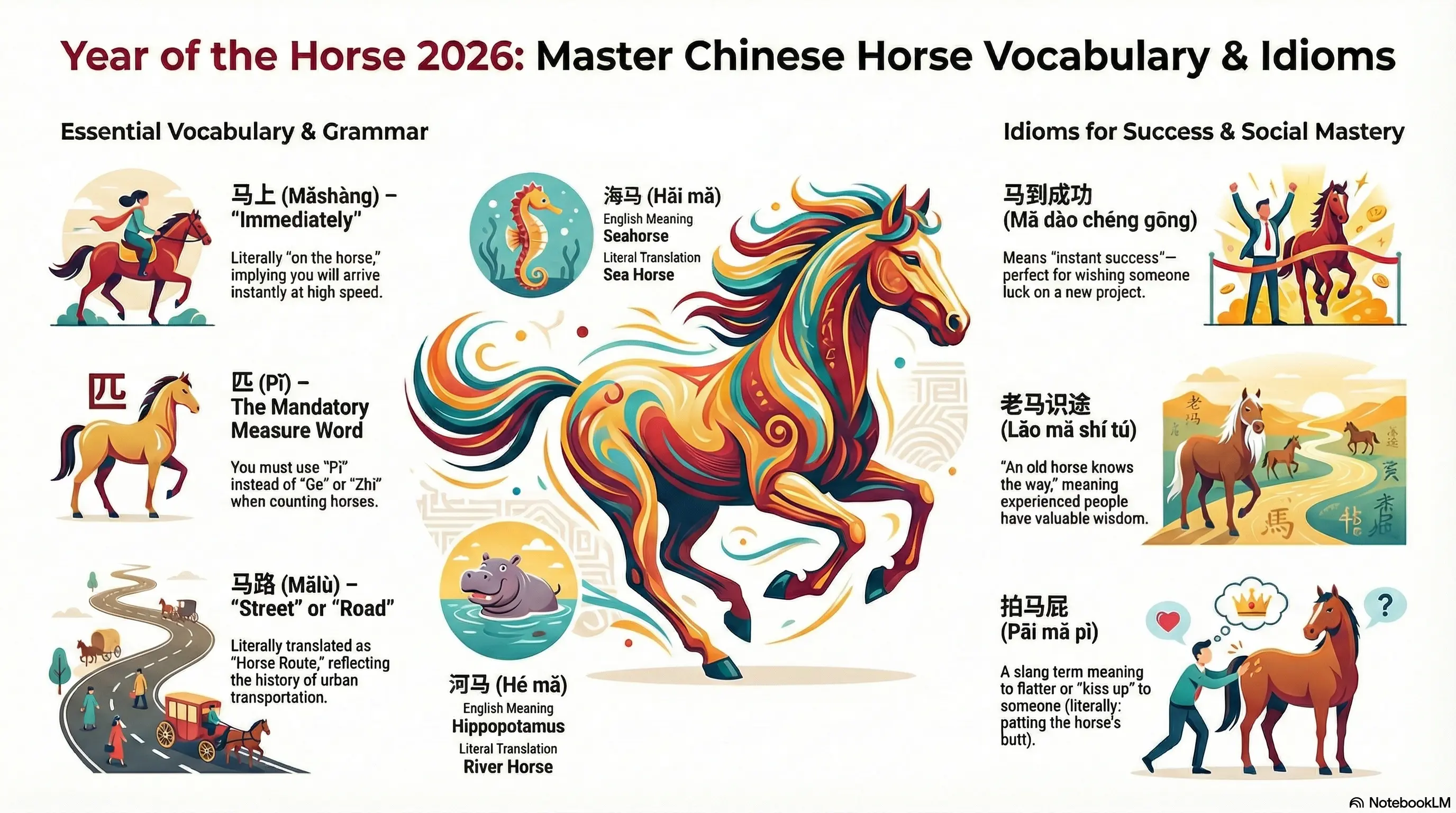
- 马上 (Mǎshàng) - Immediately / Right now.
- Literal Logic: "On the horse." If you are on a fast horse, you will arrive instantly.
- Example: 我马上来 (I'm coming immediately).
The Grammar Trap: Measure Words
When counting horses in the HSK Exam, you cannot use "Ge" (个) or "Zhi" (只). You must use a unique measure word.
- 匹 (Pǐ) - Measure word for horses.
- Example: 一匹马 (One horse).
- Note: This word is originally used for "bolts" of cloth, but exclusively applies to horses (and sometimes wolves) in the animal kingdom.
- Deep Dive: Master these rules in our Guide to Measure Words for Animals.
Horse-Related Idioms (Chengyu) for Success
In Chinese Business Culture, horse idioms are the gold standard for wishing colleagues success.
1. 马到成功 (Mǎ dào chéng gōng)
- HSK Level: 6
- Meaning: Instant success.
- Literal: The war horse arrives, and victory (success) is achieved immediately.
- Usage: The perfect phrase to say to someone starting a new job or project in 2026.
2. 老马识途 (Lǎo mǎ shí tú)
- HSK Level: 6
- Meaning: Experience matters; trust the wisdom of the old.
- Literal: An old horse knows the road/path.
- The Story: A classic exam narrative about an army that got lost in the desert but followed an old horse to safety.
- Read the full story: An Old Horse Knows the Way (Graded Reader).
3. 一马当先 (Yī mǎ dāng xiān)
- HSK Level: 6
- Meaning: To take the lead; to be at the forefront.
- Usage: Describing a company or leader who is ahead of the competition.
- Related: See how numbers interact with idioms in Chinese Idioms with Numbers.
Compound Words and Slang
The character 马 appears in many words that seem unrelated to the animal itself.
Biology and Compounds
- 海马 (Hǎi mǎ) - Seahorse (Sea + Horse).
- 河马 (Hé mǎ) - Hippopotamus (River + Horse).
- 马路 (Mǎlù) - Road / Street (Literally: Horse Route).
Modern Slang: The Flatterer
- 拍马屁 (Pāi mǎ pì) - To flatter / To kiss up.
- Literal: Patting the horse's butt.
- Origin: Historically, people would pat a general's horse to compliment him. Now, it means insincere flattery.
- Context: Essential vocabulary for understanding workplace dramas.
- Resource: Everyday Animal Slangs and Buzzwords.
Listening Comprehension Strategy
In the HSK Listening Section, mentions of "The Horse" usually imply:
- Personality: The Zodiac sign of the Horse implies someone is energetic, independent, and perhaps a bit impatient.
- Learn More: Chinese Astrology and HSK Vocabulary.
- Timing: Using words like 马上 implies urgency.
Conclusion
Mastering horse-related vocabulary gives you a distinct advantage in 2026. Whether you are using "Ma Shang" to promise a quick reply or wishing a client "Ma Dao Cheng Gong" on a new contract, these phrases are culturally powerful.
As you advance your HSK level, remember: idioms are the difference between sounding like a student and sounding like a native. Start practicing your Animal Characters today!