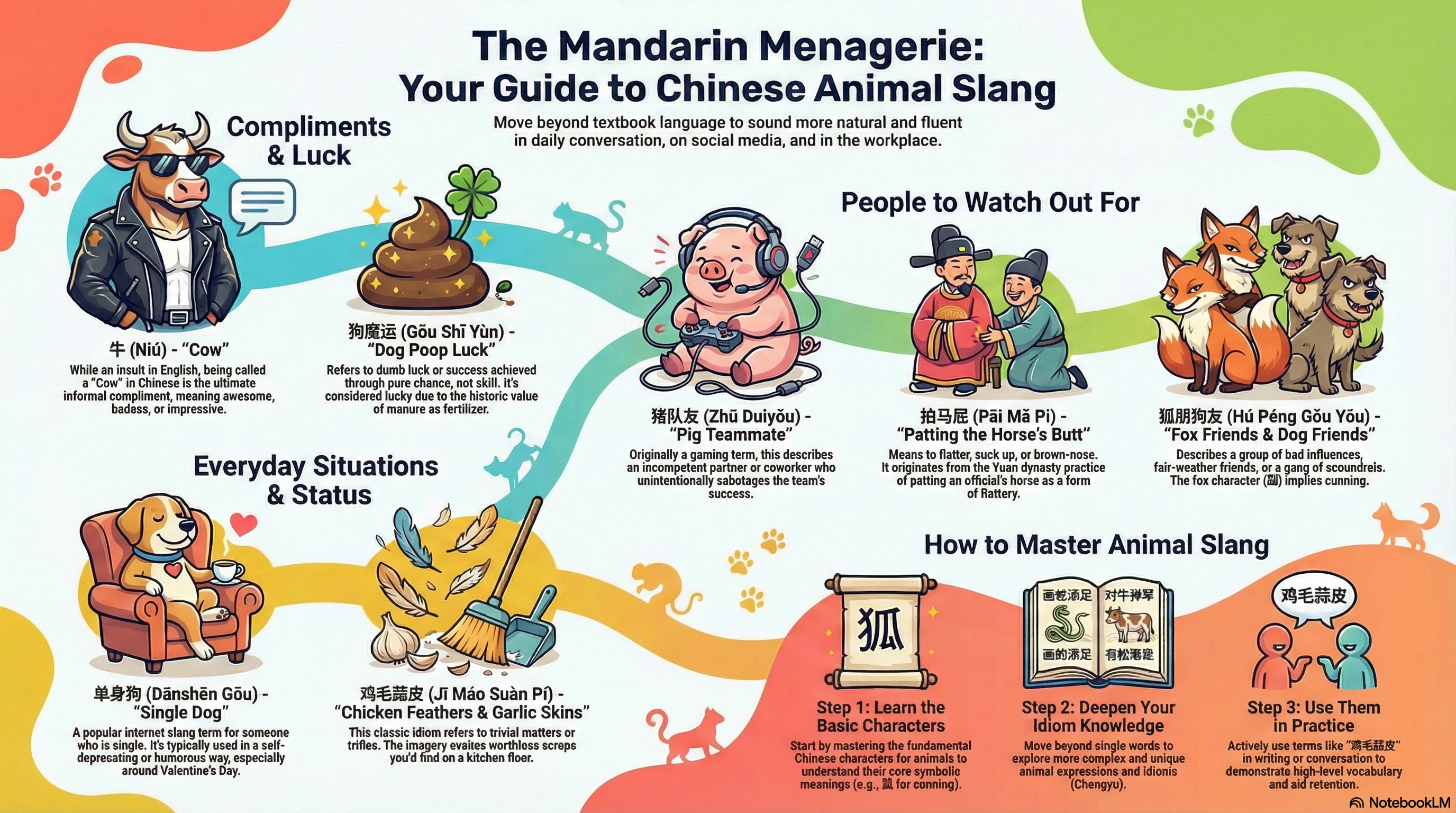
If you stick strictly to HSK textbooks, animals are just creatures you see in a zoo. In real-world Mandarin, however, animals are metaphors for personality, luck, and social status.
Understanding Animal Slang is the fastest way to bridge the gap between "Learning Chinese" and "Living in Chinese." Whether you are browsing WeChat or chatting with coworkers, these buzzwords will add color (and humor) to your fluency.
Here are the essential animal slangs that every HSK learner needs to know.
1. The High Praise: 牛 (Niú)
In English, calling someone a "Cow" is an insult. In Chinese, it is the ultimate compliment.
- Meaning: Awesome, badass, impressive, capable.
- The Vibe: Informal.
- HSK Context: While 厉害 (lìhai) is the standard adjective for "impressive," 牛 is the colloquial king.
- Example:
- 你中文说得太牛了!
- Nǐ Zhōngwén shuō de tài niú le!
- Your Chinese is freaking awesome!
2. The Workplace Hazard: 猪队友 (Zhū Duìyǒu)
Originally a gaming term, this has crossed over into office culture. It refers to the "Pig" on your team who drags everyone down.
- Literal Meaning: Pig Teammate.
- Meaning: An incompetent partner who unintentionally sabotages the group's success.
- Example:
- 不怕神一样的对手,就怕猪队友。
- Bú pà shén yíyàng de duìshǒu, jiù pà zhū duìyǒu.
- Don't fear a god-like opponent; fear a pig-like teammate.
3. The Relationship Status: 单身狗 (Dānshēn Gǒu)
This is one of the most famous Chinese Internet Slang terms of the last decade.
- Literal Meaning: Single Dog.
- Meaning: Someone who is single. It is usually used for self-deprecation (making fun of oneself) rather than insulting others.
- Context: Used heavily on Qixi Festival (Chinese Valentine's Day) and "Singles Day" (11.11).
- Example:
- 情人节又要来了,我这只单身狗只好在家看书。
- Qíngrénjié yòu yào lái le, wǒ zhè zhī dānshēn gǒu zhǐhǎo zài jiā kànshū.
- Valentine's Day is coming again; this 'Single Dog' has no choice but to stay home and read.
4. The Blind Fortune: 狗屎运 (Gǒu Shǐ Yùn)
Why is stepping in waste considered lucky? It’s agricultural humor. Manure was valuable fertilizer in ancient times.
- Literal Meaning: Dog Poop Luck.
- Meaning: Dumb luck; success obtained by pure chance rather than skill.
- Example:
- 他完全没复习就考过了 HSK 6,真是走了狗屎运。
- Tā wánquán méi fùxí jiù kǎo guò le HSK 6, zhēnshi zǒu le gǒushǐyùn.
- He passed HSK 6 without reviewing at all; it was truly dumb luck.
5. The Professional Flatterer: 拍马屁 (Pāi Mǎ Pì)
This is crucial for Business Culture.
- Literal Meaning: Patting the horse's butt/backside.
- Origin: In the Yuan dynasty, people would pat the horses of officials to compliment how strong they were.
- Meaning: To suck up; to flatter; to brown-nose.
- Example:
- 他只会拍马屁,不会干活。
- Tā zhǐ huì pāimǎpì, bú huì gànhuó.
- He only knows how to kiss up, he doesn't know how to work.
6. The Trivial Things: 鸡毛蒜皮 (Jī Máo Suàn Pí)
A classic Chengyu (Idiom) used to describe household arguments.
- Literal Meaning: Chicken feathers and garlic skins.
- Imagery: These are light, worthless scraps found on a kitchen floor.
- Meaning: Trivial matters; trifles.
- Example:
- 夫妻之间不要为了鸡毛蒜皮的小事吵架。
- Fūqī zhījiān búyào wèile jīmáosuànpí de xiǎoshì chǎojià.
- Couples shouldn't argue over trivial little things.
7. The Toxic Crowd: 狐朋狗友 (Hú Péng Gǒu Yǒu)
- Literal Meaning: Fox friends and dog friends.
- Meaning: Fair-weather friends; bad company; gang of scoundrels.
- Example:
- 别跟那些狐朋狗友混在一起了,好好学习吧。
- Bié gēn nàxiē húpénggǒuyǒu hùn zài yìqǐ le, hǎohao xuéxí ba.
- Stop hanging out with those bad influences and study hard.
Learning Strategy: From Zoo to Street
To truly master these terms, you need to understand the underlying characters. For example, knowing that 狐 (Fox) implies "cunning" helps you remember idiomatic usage.
- Step 1: Master the basics with our guide on Chinese Characters for Animals.
- Step 2: Deepen your knowledge with our specialized post on Unique Chinese Animal Expressions.
- Step 3: Use them in writing! Using an idiom like 鸡毛蒜皮 in an HSK essay demonstrates high-level vocabulary retention.
Understanding animal slang allows you to inject humor and personality into your Mandarin. Next time you see a friend succeed, give them a "thumbs up" (Hand Gesture) and tell them they are "Niu!"