If you translate directly from English to Chinese, you might say "One Teacher" as "Yī Lǎoshī." In Mandarin, this sounds as awkward as saying "One slice of cattle" instead of "One head of cattle."
Welcome to the world of Measure Words (量词 - liàngcí).
For HSK 2 students, these classifiers are the boundary between sounding like a tourist and sounding like a serious learner. In the HSK 2 exam, choosing the wrong measure word isn't just a style error; it’s a grammatical error.
In this comprehensive guide, updated for the 2026 curriculum, we categorize the essential HSK 2 measure words, explain the "Liang vs. Er" rule, and provide the grammar hacks you need to memorize them effectively.
The Logic: Why Does Chinese Have Measure Words?
In English, we usually count things directly (Three apples). We only use measure words for uncountable nouns (A cup of water, a loaf of bread).
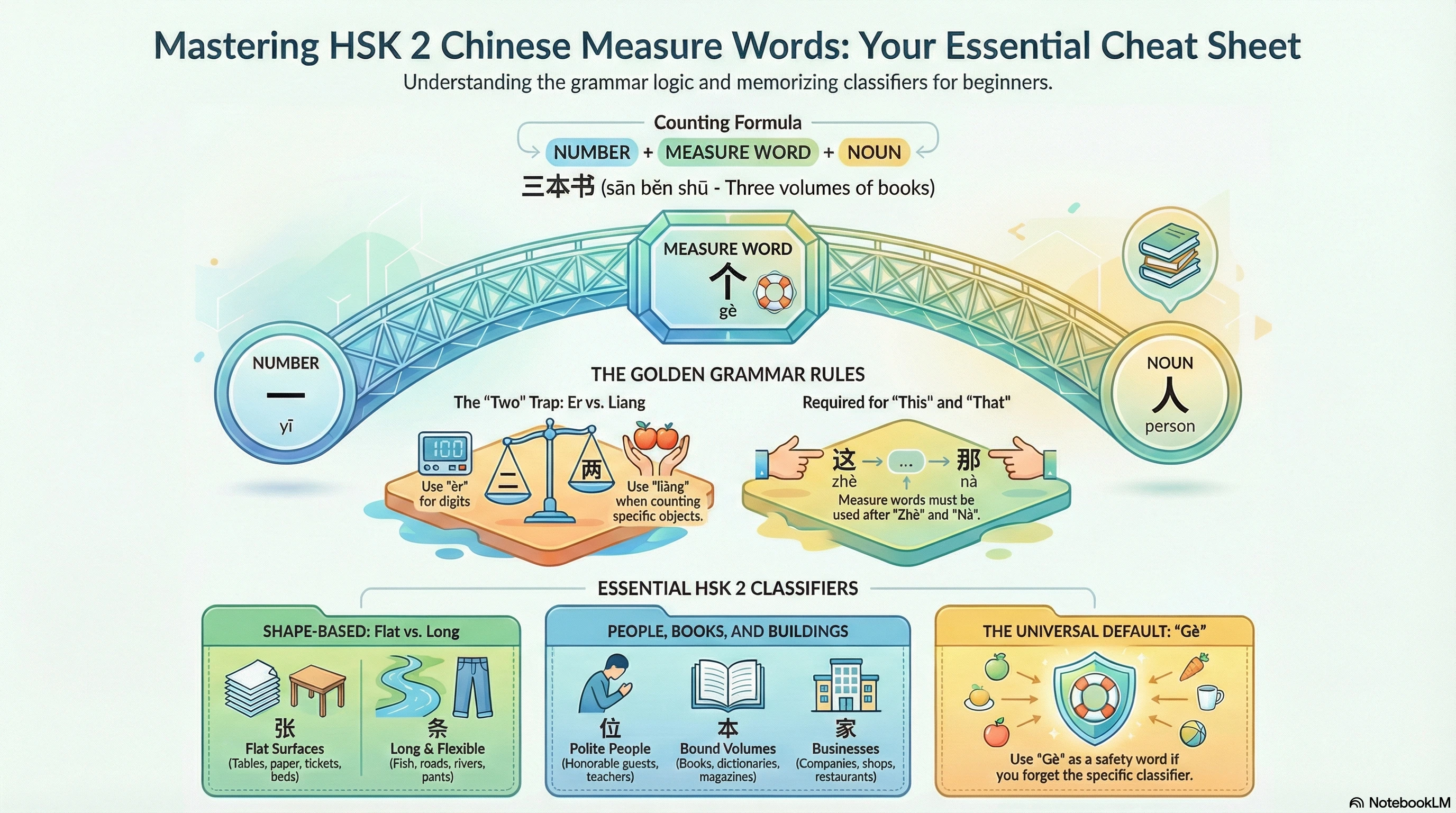
In Chinese, all nouns are uncountable. You cannot put a number directly next to a noun. You need a bridge.
The Golden Grammar Formula:
Number + [Measure Word] + Noun
- ❌ 三书 (Three book) — Incorrect
- ✅ 三本书 (Three volumes of book) — Correct
The Grammar Trap: "Two" of Something
Before we look at the words, we must fix the most common HSK 1/2 mistake.
When counting specific objects using a measure word, the number "2" changes from 二 (èr) to 两 (liǎng).
- ❌ 二个苹果 (Èr gè píngguǒ)
- ✅ 两个苹果 (Liǎng gè píngguǒ)
Tip: Just counting numbers (1, 2, 3)? Use Er. Counting objects (2 people)? Use Liang. Master this difference in our Guide to Essential Chinese Numbers.
Essential HSK 2 Measure Words by Category
To pass HSK 2, you don't need to know every classifier (there are hundreds). You need to master these high-frequency categories.
1. The Universal: 个 (gè)
Used for people, abstract ideas, and round objects.
- Examples: 一个人 (a person), 一个苹果 (an apple), 一个问题 (a question).
- Warning: While
Gèis a "safety" word if you forget the correct one, overusing it in an exam will result in lower scores.
2. People & Respect: 位 (wèi)
While Gè counts people, Wèi counts people politely. It implies status.
- Target: Teachers, Guests, Customers.
- Sentence: 我们班有三位老师。(Our class has three [respected] teachers.)
- Dive deeper into people classifiers here: Measure Words for People & Animals.
3. Flat Objects: 张 (zhāng)
Visualizes anything with a flat surface.
- Target: Tables, Paper, Tickets, Beds, Photos.
- Example: 两张票 (Two tickets).
- Note: We use
Zhāngfor "Bed" (床) because the top surface is flat.
4. Reading Materials: 本 (běn)
Literally implies a bound volume.
- Target: Books, Dictionaries, Magazines.
- Example: 这本书很有意思。(This book is very interesting).
5. Clothes and Affairs: 件 (jiàn)
Used for upper-body clothing and specific matters/affairs.
- Target: Shirt (衬衫), Coat (大衣), Gift (礼物), Matter (事情).
- Example: 我买了三件衣服。(I bought three pieces of clothing).
- For shoes/pants (which are pairs or long), the measure word changes. See Measure words for Groups & Pairs.
6. The "Long and Thin" Category: 条 (tiáo) / 支 (zhī)
- 条 (Tiáo): Flexible long things. Fish (they wiggle), Roads, Rivers, Pants (Legs are long), Skirts.
- Example: 一条裤子 (One pair of pants).
- 支 (Zhī): Rigid long things (sticks). Pens, Pencils.
- Example: 一支铅笔 (One pencil).
7. Buildings & Establishments: 家 (jiā)
Most learners miss this one! Jiā (Home) is used as a counter for businesses.
- Target: Restaurants, Companies, Hospitals, Hotels.
- Example: 哪家饭馆最好吃?(Which restaurant is the most delicious?)
- See more HSK Building & Structure Measure Words.
8. Money and Pieces: 块 (kuài)
In colloquial Chinese, we don't usually say "Yuan." We say "Kuai."
- Target: Money, Watches (sometimes), Slices (of cake/watermelon).
- Example: 五块钱 (Five "bucks").
How to Use with "This" and "That"
Measure words aren't just for counting numbers. They are required for demonstrative pronouns (This/That).
Structure: 这 (Zhè) / 那 (Nà) + [Measure Word] + Noun
- This person: 这个人 (Zhè gè rén)
- That book: 那本书 (Nà běn shū)
- Which cup? 哪个杯子? (Nǎ gè bēizi?)
Understanding location alongside quantity is vital. Check our guide on Chinese Location Words to combine these concepts ("There are three books on the table").
Practice Exercise for HSK 2
Fill in the blanks (Try to guess before scrolling down):
- One _____ cat (猫).
- Three _____ computers (电脑 - Note: HSK 2 usually accepts 'ge' or 'tai').
- Two _____ chairs (椅子 - Hint: It has a flat handle/surface!).
- Five _____ of money (钱).
(Answers: 1. 只 zhī; 2. 台 tái or 个 gè; 3. 把 bǎ; 4. 块 kuài)
HSK Strategy: When in doubt...
If you are taking the HSK exam and completely forget if a hat is "Ding" (顶) or "Jian" (件):
- Don't leave it blank.
- Do use 个 (Gè). It is the "universal default." While technically incorrect for things like paper, it communicates the grammatical slot of a measure word, which usually earns partial credit over missing logic.
However, for common items like books (Ben), paper (Zhang), and clothes (Jian), memorizing the specific character is non-negotiable for passing HSK 2 reading sections.
Conclusion
Measure words are a lens into how Chinese culture categorizes the world—by shape, function, and respect.
Don't memorize them as a boring list. Group them visually:
- Flat? -> Zhang.
- Long/Wiggly? -> Tiao.
- Bound like a book? -> Ben.
Start observing objects in your room today. Point to them and say: "Zhe [Measure Word] Noun" (e.g., 这张床). You will find that Mastering Measure Words becomes a habit, not a chore.
Good luck with your HSK 2 prep! 加油 (Jiāyóu)!