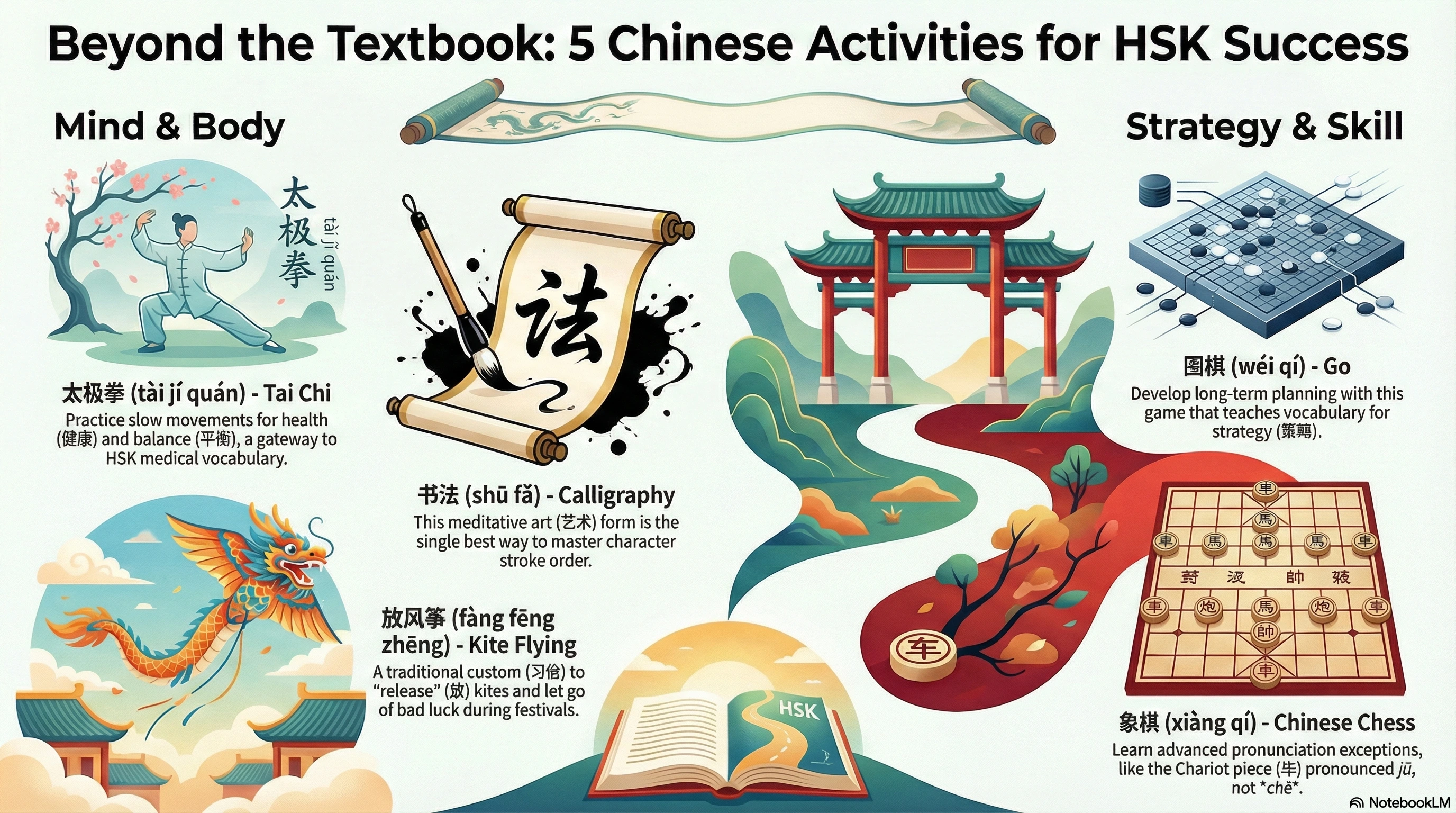
Textbooks often focus on generic sports like basketball or swimming. However, exploring uniquely Chinese sports and activities not only enriches your understanding of the culture but also prepares you for the "Culture" section often found in HSK 4-6 reading exams.
Integrating HSK vocabulary and grammar while learning about these traditional pastimes can make your study sessions more immersive. Here are five activities that define Chinese leisure life.
1. 太极拳 (tài jí quán) - Tai Chi
Vocabulary and Grammar:
- 太极拳 (tài jí quán) - Tai Chi
- 练习 (liàn xí) - To practice (HSK 3)
- 健康 (jiàn kāng) - Health (HSK 2)
- 平衡 (píng héng) - Balance (HSK 5)
Tai Chi is a traditional martial art known for its slow, deliberate movements and deep breathing. You will often see elderly people doing this in parks at 6 AM.
For HSK learners, this topic is a gateway to medical and health vocabulary. Note the verb 练习 (liàn xí); it is commonly used for skills that require repetition, such as 练习太极拳 (practicing Tai Chi) or 练习听力 (practicing listening).
2. 书法 (shū fǎ) - Calligraphy
Vocabulary and Grammar:
- 书法 (shū fǎ) - Calligraphy
- 毛笔 (máo bǐ) - Writing brush
- 墨 (mò) - Ink
- 艺术 (yì shù) - Art (HSK 4)
Calligraphy is more than just writing; it is a meditative art form. Using a 毛笔 (máo bǐ) on paper helps you understand the flow and structure of Hanzi.
For HSK students, practicing calligraphy is the single best way to master stroke order. Read more about the role of calligraphy in HSK preparation to see how it can boost your character retention.
3. 围棋 (wéi qí) - Go
Vocabulary and Grammar:
- 围棋 (wéi qí) - Go (The game)
- 棋盘 (qí pán) - Chessboard
- 棋子 (qí zǐ) - Chess pieces
- 策略 (cè lüè) - Strategy (HSK 6)
围棋 (wéi qí) is a strategic board game that emphasizes territory and patience. It is often cited in business contexts to describe long-term planning.
Discussing 围棋 is a great way to practice Chinese idioms related to thinking and strategy, such as 举棋不定 (jǔ qí bù dìng - holding a chess piece undecided; meaning to hesitate).
4. 风筝 (fēng zhēng) - Kite Flying
Vocabulary and Grammar:
- 风筝 (fēng zhēng) - Kite
- 放 (fàng) - To release / To fly (a kite)
- 天空 (tiān kōng) - Sky
- 习俗 (xí sú) - Custom / Tradition (HSK 5)
Flying kites, or 放风筝 (fàng fēng zhēng), is not just for kids in China. It is a traditional activity often associated with the Tomb Sweeping Festival (Qingming), where people fly kites to let go of bad luck and illnesses.
Grammar Note: The verb 放 (fàng) is versatile. It is used for "releasing" things: 放假 (to go on holiday), 放心 (to rest one's heart/relax), and 放风筝 (to fly a kite).
5. 象棋 (xiàng qí) - Chinese Chess
Vocabulary and Grammar:
- 象棋 (xiàng qí) - Chinese chess
- 将军 (jiāng jūn) - General / "Check" (in chess)
- 车 (chē/jū) - Rook / Chariot
- 马 (mǎ) - Horse / Knight
象棋 (xiàng qí) is a common sight on street corners in China. Note that the piece "Chariot" (车) is pronounced jū in the context of Chess, not chē (car). Knowing these pronunciation exceptions is a mark of an advanced learner.
Incorporating These Activities into HSK Study
Engaging in these traditional Chinese activities can make your HSK preparation more enjoyable.
- Learn Vocabulary Through Context: Don't just memorize "Strategy"; associate it with a game of Go.
- Grammar Practice: Use the verb 练习 (liàn xí) to describe your study routine in your daily HSK study plan.
- Cultural Understanding: HSK 6 exams often ask about the history of these items.
Conclusion
Exploring these five uniquely Chinese sports—Tai Chi, Calligraphy, Go, Kite Flying, and Xiangqi—provides practical opportunities to apply HSK vocabulary. By integrating these activities, you’ll find that your language skills improve as you connect more deeply with the culture.
For more ways to connect your language study to the real world, check out our guide on finding the real China through HSK study.