One of the first culture shocks for HSK learners is realizing that translating "Mr." and "Mrs." directly from English often leads to awkward stares.
In Chinese culture, how you address someone defines the relationship. It establishes hierarchy, respect, and intimacy. Calling a CEO "Mr. Zhang" might sound polite in English, but in Chinese business culture, it can actually demote their status!
Whether you are preparing for HSK 2 or negotiating a deal in Shanghai, mastering these terms is essential. Here is your comprehensive guide to addressing people in Chinese without losing face.
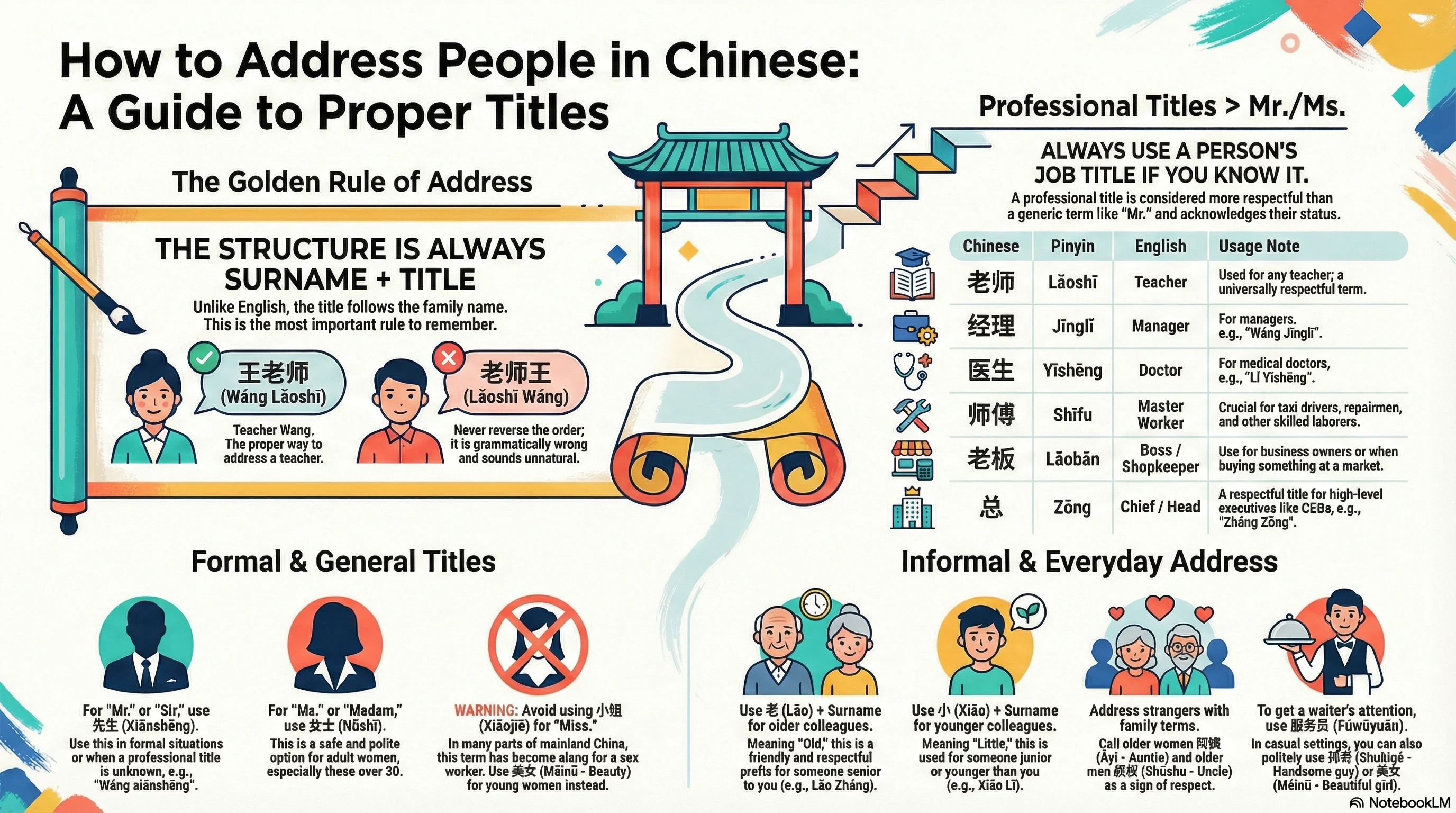
1. The Golden Rule: Title After Surname
In English, we put titles first (Mr. Smith). In Chinese, the order is reversed:
Structure: Surname + Title
- English: Teacher Wang
- Chinese: 王老师 (Wáng lǎoshī)
- Wrong: 老师王 (Lǎoshī Wáng) - Never say this!
This applies to almost every job title in the HSK vocabulary list.
2. Professional Titles: Forget "Mr." and "Ms."
In China, a person’s job title is often their identity. If someone has a title, use it. It is considered more respectful than "Mister."
The "Must-Know" HSK Titles
| Chinese | Pinyin | English | Usage Note |
|---|---|---|---|
| 老师 | Lǎoshī | Teacher | Used for ANY teacher. Universally respectful. |
| 经理 | Jīnglǐ | Manager | HSK 4 business term. "Wáng Jīnglǐ". |
| 医生 | Yīshēng | Doctor | "Lǐ Yīshēng". |
| 师傅 | Shīfu | Master/Skilled Worker | Essential! Used for taxi drivers and repairmen. |
| 老板 | Lǎobǎn | Boss/Shopkeeper | Used at markets or for business owners. |
| 总 | Zǒng | Chief/Head | Short for Zǒngjīnglǐ. Used for CEOs. e.g., "Zhāng Zǒng." |
Study Tip: If you are learning Business Mandarin, replace "Xiānshēng" with the specific job title immediately.
3. Formal Address: The "Safe" Words
When you don't know someone's job title, or in extremely formal situations (like an embassy or gala), use these gender-specific titles.
- 先生 (Xiānshēng) - Mr. / Sir
- Usage: "Wáng xiānshēng" (Mr. Wang).
- Note: It is also used to refer to one's husband in formal conversation.
- 女士 (Nǚshì) - Ms. / Madam
- Usage: "Lǐ nǚshì" (Ms. Li).
- Note: Safe for women of any age (usually over 30).
⚠️ The Danger of "小姐" (Xiǎojiě)
In old textbooks, 小姐 (Xiǎojiě) is taught as "Miss."
- The Trap: In some regions and contexts (especially karaoke bars or massage parlors), "Xiǎojiě" is slang for a sex worker.
- The Fix: Unless you are in Taiwan or a high-end hotel, avoid calling a stranger "Xiaojie." Use 美女 (Měinǚ - Beauty) for young women or just 你好 (Nǐhǎo) to get attention.
4. Addressing Colleagues and Friends: Lao (老) and Xiao (小)
In a friendly workspace or neighborhood, using full titles feels too stiff. Chinese uses prefixes to show closeness based on age.
- 老 (Lǎo - Old) + Surname: Used for someone older than you or senior in rank.
- Example: 老张 (Lǎo Zhāng) - "Old Zhang" (Friendly respect).
- 小 (Xiǎo - Little) + Surname: Used for someone younger or junior.
- Example: 小李 (Xiǎo Lǐ) - "Little Li."
Cultural Insight: Being called Lǎo isn't an insult to your age; it's a nod to your experience!
5. Addressing Strangers (Service Staff)
How do you get a waiter's attention? "Excuse me" (Duìbuqǐ) is rare in this context.
- 服务员 (Fúwùyuán): The standard "Waiter/Waitress." HSK 2 vocabulary.
- 帅哥 / 美女 (Shuàigē / Měinǚ): "Handsome guy / Beautiful girl."
- Context: Extremely common in casual restaurants or markets. It sounds flirtatious in English, but it's just polite fluff in Chinese.
Learn more about interacting with locals in our guide to Chinese greetings other than Ni Hao.
6. Family Terminology (HSK 1 Basics)
Chinese family trees are notoriously complex, with different words for "mother's brother" vs "father's brother." For HSK 1, stick to the basics, but remember that strangers are often addressed as family too!
- 阿姨 (Āyí): Auntie.
- Crucial Usage: Also used for cleaning ladies, older female neighbors, or friends' mothers.
- 叔叔 (Shūshu): Uncle.
- Crucial Usage: Used for older men you don't know well.
Review the core Chinese pronouns and grammar to ensure you are connecting these titles correctly.
Grammar Point: Do you need "De"?
A common question is whether to use 的 (de).
- With pronouns: 我的老师 (Wǒ de lǎoshī) - My teacher. (Requires De usually).
- Direct Address: You never say "Hello, my teacher." You just say "Teacher, hello!" (老师好 - Lǎoshī hǎo).
Conclusion
Correctly addressing someone is about 50% language and 50% Confucius teachings. It shows you understand your place relative to theirs.
Summary Checklist:
- Surname first, Title second.
- Job Titles > Mr./Ms.
- Use "Lao/Xiao" for friends.
- Be careful with "Xiaojie."
- Call your taxi driver "Shifu."
Master these rules, and you'll find that Chinese people open up to you much faster. Proper address builds immediate rapport!