For HSK learners striving to master Mandarin Chinese, understanding the teachings of Confucius (孔子, Kǒngzǐ) is more than a history lesson—it is a survival skill for HSK Levels 5 and 6.
Reading comprehension passages often feature anecdotes about morality, education, and family structure. These are almost always rooted in Confucian thought. This article provides the high-value vocabulary and philosophical context needed to answer these exam questions correctly.
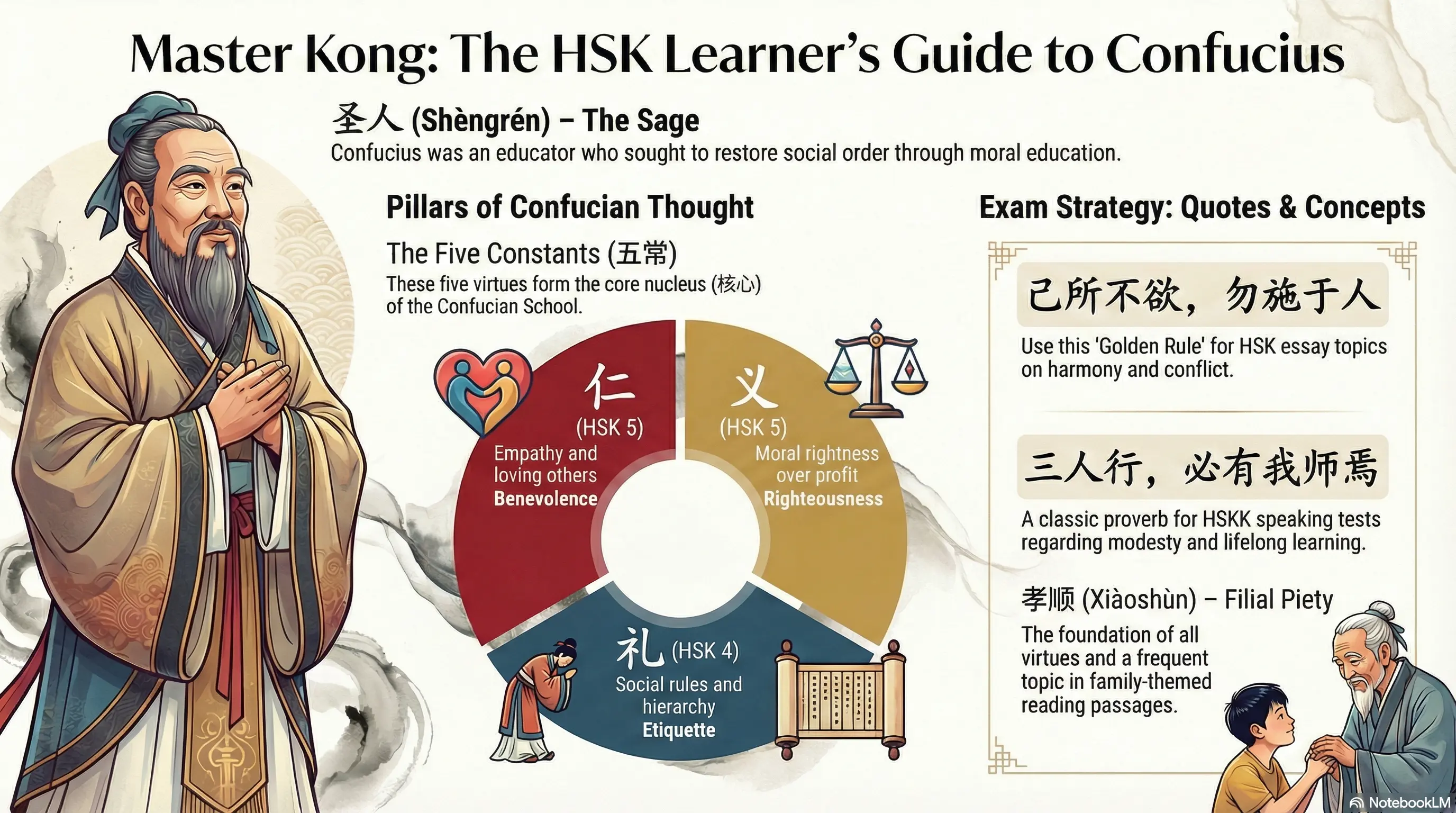
Who Was Master Kong?
Confucius (551-479 BCE) lived during the chaotic "Spring and Autumn Period." He was not a god, but a teacher who sought to restore order through moral education.
Essential HSK Vocabulary: The Identity
- 孔子 (Kǒngzǐ) - Confucius (HSK 4). Note: "Zi" is an honorific suffix for "Master."
- 圣人 (Shèngrén) - Sage / Saint (HSK 6).
- 儒家 (Rújiā) - Confucianism / Confucian School (HSK 6).
- 教育家 (Jiàoyùjiā) - Educator (HSK 5).
- 核心 (Héxīn) - Core / Nucleus (HSK 5).
Grammar Point: The "Not only... but also..." Structure
When describing historical figures, use this classic pattern.
- Structure: S + 不仅 + [Trait A], 而且 + [Trait B].
- Sentence: 孔子不仅是一位哲学家,而且是一位伟大的教育家。
- (Kǒngzǐ bùjǐn shì yī wèi zhéxuéjiā, érqiě shì yī wèi wěidà de jiàoyùjiā.)
- Confucius was not only a philosopher but also a great educator.
Deep Dive: Want to read the original texts? Check out our dedicated guide on The Analects: The Cornerstone of Chinese Literature.
The 5 Virtues: Reading Comprehension Keys
If a reading passage discusses "morality" (道德), the answer usually lies in one of these five concepts. Memorizing these characters allows you to speed-read philosophy texts.
- 仁 (Rén) - Benevolence / Humaneness (HSK 5)
- Concept: Empathy; loving others.
- 义 (Yì) - Righteousness / Justice (HSK 5)
- Concept: Doing what is morally right, regardless of profit.
- 礼 (Lǐ) - Etiquette / Propriety / Rites (HSK 4)
- Concept: Following social rules and respecting hierarchy.
- 智 (Zhì) - Wisdom (HSK 5)
- 信 (Xìn) - Trustworthiness / Integrity (HSK 4)
Study Tip: Group these as the "Five Constants" (五常 - Wǔcháng) in your notes.
Grammar Point: Expressing Beliefs (认为)
- Structure: Person + 认为 (Rènwéi) + [Opinion].
- Sentence: 儒家认为“孝顺”是所有美德的基础。
- (Rújiā rènwéi “xiàoshùn” shì suǒyǒu měidé de jīchǔ.)
- Confucianism believes "Filial Piety" is the foundation of all virtues.
Famous Quotes for HSK Essays
Using a quote (名言 - míngyán) in the HSK Writing Section demonstrates deep cultural fluency and can boost your score.
1. The Golden Rule
己所不欲,勿施于人。 (Jǐ suǒ bù yù, wù shī yú rén.) Translation: Do not do to others what you do not want done to yourself.
- Usage: Use this when writing about interpersonal conflict or social harmony.
2. The Growth Mindset
三人行,必有我师焉。 (Sān rén xíng, bì yǒu wǒ shī yān.) Translation: Among three people walking, there will certainly be one who can be my teacher.
- Usage: Use this in the HSKK (Speaking) test when asked about "How to learn" or "The importance of modesty."
- Grammar: The particle 焉 (yān) means "in it/among them" in Classical Chinese.
More Quotes: We have analyzed the grammar of this proverb in detail in our post: Proverbs and Meanings for HSK Learners.
Modern Relevance: HSK Topics
Confucianism isn't just ancient history; it shapes modern HSK reading topics regarding Family and Education.
- 孝顺 (Xiàoshùn) - Filial Piety (HSK 5).
- Topic: Children taking care of elderly parents.
- 尊师重道 (Zūn shī zhòng dào) - Respect teachers and revere the Way.
- Topic: The high pressure of the Gaokao University Entrance Exam.
- 和谐 (Héxié) - Harmonious (HSK 5).
- Topic: Social stability and resolving conflict.
Exam Context: A common question type asks, "What would the author likely agree with?" If the passage mentions elders, the answer usually aligns with "Respecting tradition" or "Taking care of parents."
Confucius Institutes and Learning
Vocabulary related to the modern spread of these ideas often appears in listening sections about "Study Abroad."
- 孔子学院 (Kǒngzǐ Xuéyuàn) - Confucius Institute.
- 交流 (Jiāoliú) - Exchange / Communicate (HSK 4).
- 传播 (Chuánbō) - To disseminate / spread (HSK 5).
Conclusion: Ancient Wisdom, Modern Scores
Confucius said: "Review the old to learn the new" (温故而知新). This is excellent advice for HSK students.
By understanding these ancient philosophical pillars, you are not just memorizing words like "Ren" and "Yi"; you are learning the logic behind Chinese culture. This cultural intuition makes guessing vocabulary in context much easier during the exam.
Ready to explore more cultural figures? Read our guide on The Legend of Yu the Great to understand the vocabulary of Chinese history and resilience.