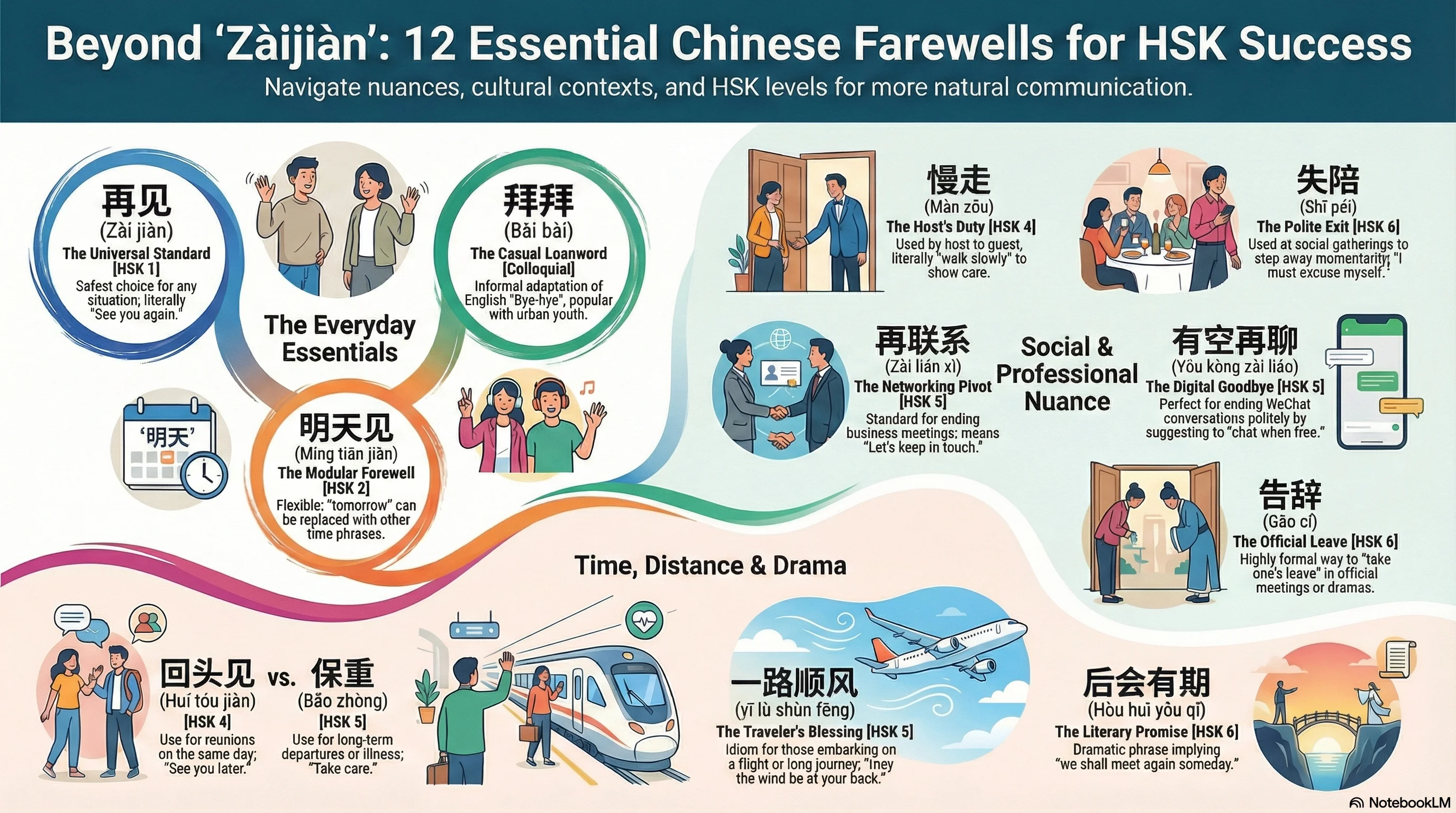
In language learning, how you end a conversation is just as important as how you start it. While you might have already mastered greetings other than Nihao, using the same word for "Goodbye" in every situation can make your speech sound robotic.
For HSK learners, mastering varied farewells is crucial for the HSKK (Speaking) exam and real-life fluency. Here are 12 essential ways to say goodbye, categorized by their specific cultural context and HSK level.
1. 再见 (Zài jiàn) - The Universal Goodbye
HSK Level: 1 Cultural Context: Neutral and widely applicable.
再 (zài) means "again" and 见 (jiàn) means "to see." Therefore, this literally means "See you again." It is the safest choice for HSK 1 learners as it can be used with friends, bosses, or strangers.
Usage Example:
- A: 我要走了。(Wǒ yào zǒu le.) - I have to go.
- B: 好的,再见!(Hǎo de, zài jiàn!) - Okay, goodbye!
2. 拜拜 (Bài bài) - The Casual Farewell
HSK Level: Colloquial (Essential for Daily Life) Cultural Context: Informal, extremely popular among urban youth.
A loanword from the English "Bye-bye." While not strict "HSK Vocabulary," it appears constantly in contemporary dramas and casual dialogues.
Usage Example:
- 朋友们,拜拜!(Péngyou men, bài bài!) - Friends, bye-bye!
3. 回头见 (Huí tóu jiàn) - See You Later
HSK Level: 4 Cultural Context: Casual; implies a reunion within the same day or very soon.
Literally translating to "turn [one's] head [and] see," this implies you will circle back to see the person shortly. Do not use this if you won't see them for weeks.
Usage Example:
- 我先走了,回头见!(Wǒ xiān zǒu le, huí tóu jiàn!) - I'm leaving first, catch you later!
- Grammar Note: Notice the use of 先 (xiān) to indicate the first sequence of an action.
4. 再联系 (Zài lián xì) - Let's Keep in Touch
HSK Level: 5 Cultural Context: Polite, Professional, Networking.
This is the "go-to" phrase for ending a business meeting or catching up with an old acquaintance. It is crucial for Business Mandarin.
Usage Example:
- 有事我们再联系。(Yǒu shì wǒmen zài lián xì.) - We'll be in touch if anything comes up.
5. 保重 (Bǎo zhòng) - Take Care
HSK Level: 5 Cultural Context: Used when parting for a long time, or if the other person is unwell/traveling.
保重 (bǎo zhòng) shows deep concern. You wouldn't say this to a colleague you will see tomorrow morning; you would say it to a friend moving to another country.
Usage Example:
- 长途旅行要保重啊。(Chángtú lǚxíng yào bǎo zhòng a.) - Take care on your long journey.
6. 慢走 (Màn zǒu) - "Go Slowly" (Host to Guest)
HSK Level: 4 Cultural Context: Extreme Politeness. Used specifically by hosts when guests are leaving.
This reflects Chinese dining etiquette and hospitality. The host says 慢走 (Walk slowly/Watch your step) to show they care about the guest's safety on the way out.
Usage Example:
- Guest: 我走了。(I'm going.)
- Host: 慢走,路上小心。(Take care/Walk slowly, be careful on the way.)
7. 后会有期 (Hòu huì yǒu qī) - We'll Meet Again (Someday)
HSK Level: 6 Cultural Context: Formal, literary, or dramatic.
This is a favorite in Wuxia (martial arts) movies. It implies uncertainty about when you will meet, but certainty that you will meet. It is a sophisticated phrase for HSK 6 essays.
Usage Example:
- 虽然现在分别,但我相信后会有期。(Suīrán xiànzài fēnbié, dàn wǒ xiāngxìn hòu huì yǒu qī.)
8. 明天见 (Míng tiān jiàn) - See You Tomorrow
HSK Level: 2 Cultural Context: Casual, specific.
You can swap 明天 (tomorrow) with any time word. This is a modular phrase.
- 一会儿见 (Yīhuìr jiàn) - See you in a moment.
- 下周见 (Xià zhōu jiàn) - See you next week.
9. 有空再聊 (Yǒu kòng zài liáo) - Chat When Free
HSK Level: 5 Cultural Context: The "Text Message" Goodbye.
Commonly used to end a chat on WeChat when you need to run errands. It softens the blow of leaving the conversation.
Usage Example:
- 我现在要走了,有空再聊吧。 (I have to run, let's chat when free.)
10. 失陪 (Shī péi) - Excuse Me (I Must Step Away)
HSK Level: 6 Cultural Context: Formal, social gatherings.
Literally "lose [your] company." Used when you are at a dinner party and need to leave the table to use the restroom or answer a phone call. It is highly polite.
Usage Example:
- 对不起,我现在要失陪一下。(Duìbuqǐ, wǒ xiànzài yào shī péi yíxià.) - Apologies, I must excuse myself for a moment.
11. 告辞 (Gào cí) - I Take My Leave
HSK Level: 6 Cultural Context: Very formal, somewhat archaic or highly official.
告辞 showcases the classical influence in modern Chinese. You might hear this in period dramas or very formal resignation meetings.
Usage Example:
- 时间不早了,我该告辞了。(Shíjiān bù zǎo le, wǒ gāi gào cí le.) - It is late, I ought to take my leave.
12. 一路顺风 (Yī lù shùn fēng) - Bon Voyage
HSK Level: 5 Cultural Context: Used when someone is departing on a flight or long journey.
This is a specific idiom (Chengyu). Literally: "The whole journey follow the wind." If you are interested in phrases like this, check out our list of Chinese idioms for HSK success.
Usage Example:
- 祝你一路顺风!(Zhù nǐ yī lù shùn fēng!) - Have a safe flight/journey!
Conclusion: Ending on a High Note
Mastering these 12 ways to say goodbye will significantly boost your HSK performance.
- Listening: You will recognize the relationship between speakers (Are they host/guest? Boss/employee?).
- Speaking: You will sound more emotionally intelligent by choosing the right farewell.
To further sound like a local, remember that saying goodbye is often preceded by "Small Talk." Brush up on how to make small talk in Chinese before you make your exit.
Keep practicing, and 祝你学习成功 (Zhù nǐ xuéxí chénggōng) — Wishing you success in your studies!