Mastering Chinese measure words (classifiers) is a crucial step in your journey to HSK success. While English uses them occasionally (a slice of bread, a flock of birds), Mandarin uses them for almost every noun.
Many beginners fall into the trap of using the "universal" measure word 个 (gè) for everything. While you will be understood, overusing it sounds unnatural and marks you as a beginner. To reach HSK Level 3 and above, you need to be specific.
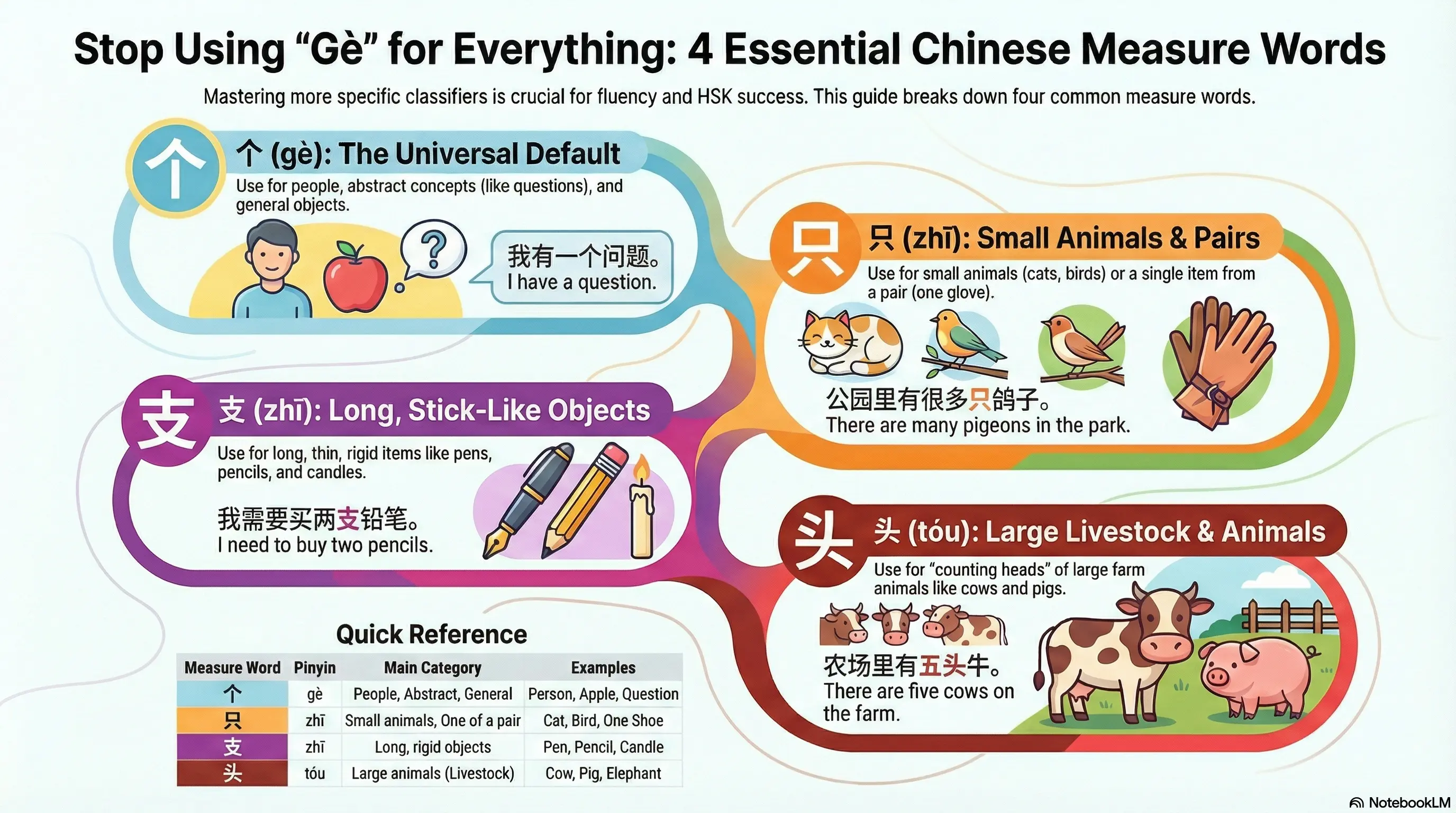
In this article, we'll explore four common measure words that appear frequently in exams: 个 (gè), 只 (zhī), 支 (zhī), and 头 (tóu).
Why Measure Words Matter in HSK
Before we dive into the specific words, let's understand why classifiers are tested so heavily in HSK:
- Grammar Accuracy: Correct usage prevents ambiguity.
- Visual Logic: Chinese measure words often describe the shape of the object (long, flat, round).
- Exam Scoring: In the HSK writing section, using the correct measure word is an easy way to gain points for "vocabulary richness."
For a deeper dive into the logic behind these words, check out our guide on understanding Chinese measure words.
1. 个 (gè): The "Universal" Classifier
Overview
个 (gè) is the most versatile measure word in Mandarin. It is the default classifier for people and abstract concepts, but it should not be your only classifier.
Usage in HSK Context
- People: The most standard usage.
Example: 班上有二十个学生。
(Bān shàng yǒu èrshí gè xuéshēng.)
There are twenty students in the class. - Abstract Concepts: Time, questions, or ideas.
Example: 我有一个问题。
(Wǒ yǒu yí gè wèntí.)
I have a question. - Generic Objects: Fruit (apples/oranges) often use this.
HSK Study Tip
In HSK Level 1, it is acceptable to use 个 for almost everything. However, as you advance, try to replace it with specific classifiers whenever possible to demonstrate higher proficiency.
2. 只 (zhī): Small Animals and "One of a Pair"
Overview
只 (zhī) is essential for describing the animal kingdom, but it has a tricky secondary usage: describing single items that usually come in pairs (like hands or shoes).
Usage in HSK Context
- Small Animals: Cats, dogs, birds, and insects.
Example: 公园里有很多只鸽子。
(Gōngyuán lǐ yǒu hěnduō zhī gēzi.)
There are many pigeons in the park. - One of a Pair: This is a common HSK trap. A pair of hands is 一双 (shuāng), but one hand is 一只.
Example: 这只手套是红色的。
(Zhè zhī shǒutào shì hóngsè de.)
This (single) glove is red.
HSK Study Tip
Group your vocabulary learning. When you study animal vocabulary, memorize the measure word immediately. Remember: Small animal = 只.
3. 支 (zhī): The "Stick-Like" Objects
Overview
支 (zhī) implies that an object is long, thin, and relatively rigid (like a stick or a branch). It is distinct from 条 (tiáo), which is used for long, flexible things (like pants or snakes).
Usage in HSK Context
- Writing Instruments: Pens, pencils, and brushes.
Example: 我需要买两支铅笔。
(Wǒ xūyào mǎi liǎng zhī qiānbǐ.)
I need to buy two pencils. - Rod-like Objects: Cigarettes, candles, or even rifles.
Example: 桌上有一支蜡烛。
(Zhuō shàng yǒu yì zhī làzhú.)
There's a candle on the table.
HSK Study Tip
Visual association is key here. If the object looks like a branch or a stick, try 支. This is vital for describing stationery in HSK writing tasks.
4. 头 (tóu): The "Head" of Livestock
Overview
头 (tóu) literally means "head." In the context of measure words, it is used primarily for large animals, specifically livestock. It gives the sense of "counting heads" of cattle.
Usage in HSK Context
- Livestock: Cows, oxen, pigs, mules.
Example: 农场里有五头牛。
(Nóngchǎng lǐ yǒu wǔ tóu niú.)
There are five cows on the farm. - Large Wild Animals: Elephants, rhinos.
Example: 动物园里有两头大象。
(Dòngwùyuán lǐ yǒu liǎng tóu dàxiàng.)
There are two elephants in the zoo.
HSK Study Tip
Do not mix this up with 只. A cat is small (只), but a cow is big (头).
- Exception: A horse is usually counted with 匹 (pǐ), not 头.
Quick Summary Table
| Measure Word | Pinyin | Main Category | Examples |
|---|---|---|---|
| 个 | gè | People, Abstract, General | Person, Apple, Question |
| 只 | zhī | Small animals, One of a pair | Cat, Bird, One Shoe |
| 支 | zhī | Long, rigid objects | Pen, Pencil, Candle |
| 头 | tóu | Large animals (Livestock) | Cow, Pig, Elephant |
Practical Application for HSK Success
To excel in your HSK exams and improve your overall Mandarin proficiency, here are some strategies:
- Contextual Learning: Don't memorize lists; memorize phrases. Instead of "支 = pen," memorize "一支笔" (one pen).
- Error Analysis: Watch out for common mistakes, such as using 个 for family members when a more respectful term (like 位 wèi) or specific term (like 口 kǒu) might be needed in higher levels.
- Listening Practice: Train your ear. In listening exams, the measure word often hints at the noun that follows, helping you predict the answer even if you missed the noun itself.
Conclusion
Mastering these four common Chinese measure words – 个, 只, 支, and 头 – distinguishes a serious learner from a casual tourist. They provide visual context to your sentences and are essential for scoring well in HSK levels 2 and 3.
By incorporating these into your regular study routine, you'll not only improve your test scores but also gain a deeper appreciation for the logic of the Chinese language. 加油 (Jiāyóu) with your studies!