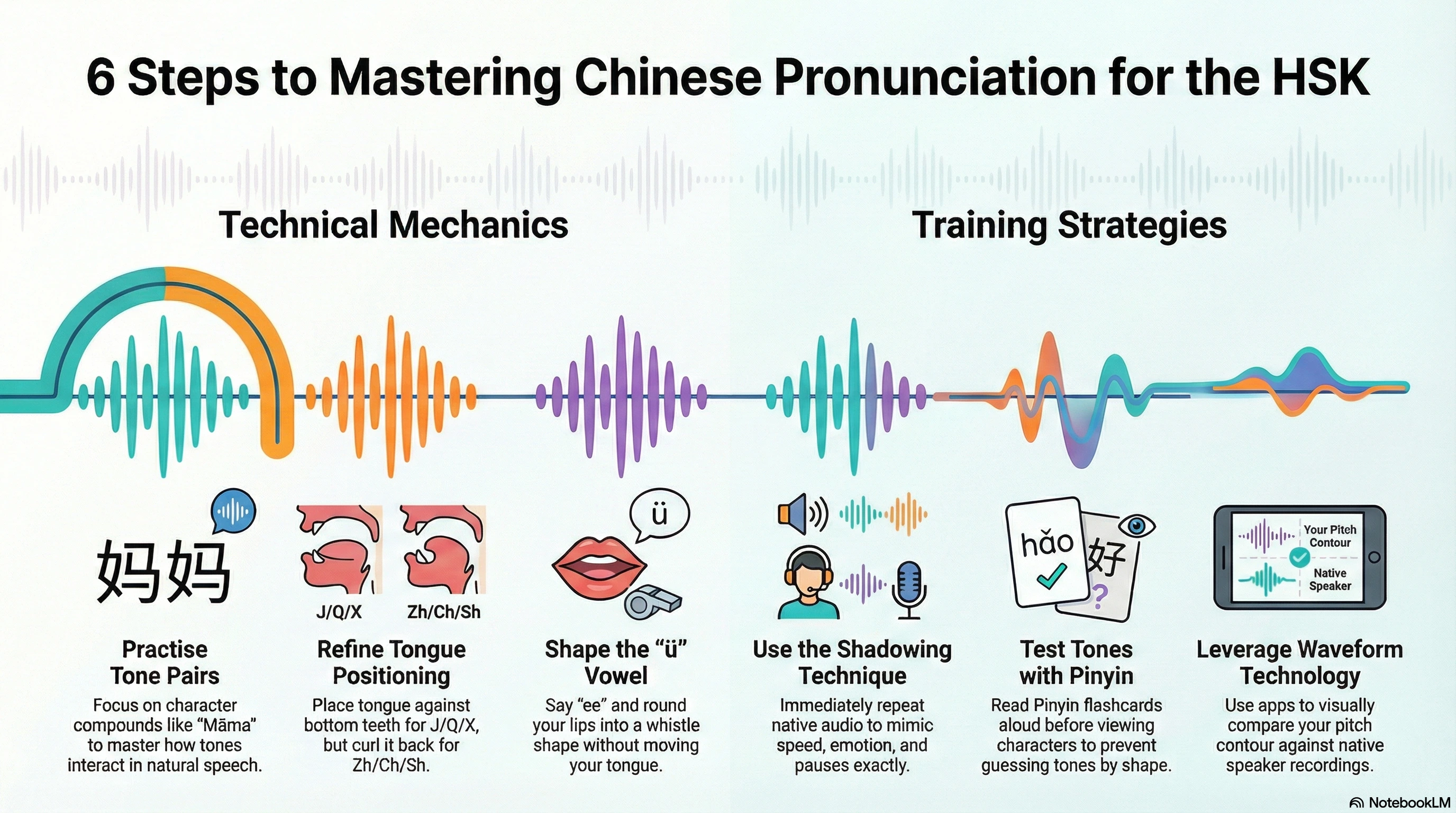
Mastering Chinese pronunciation is the difference between passing the HSK and actually being understood by a native speaker.
While written exams test your vocabulary, the HSK Speaking test (HSKK) and everyday communication require muscle memory. Bad pronunciation can also hurt your listening scores—if you can't say it correctly, you often can't hear it correctly.
By following these six steps, you can refine your accent and boost your overall performance.
1. Master the Tones (Especially Tone Pairs)
The foundation of Chinese pronunciation lies in its tonal system. The HSK exam requires a solid grasp of the four main tones plus the neutral tone.
However, a common mistake is practicing tones in isolation. In HSK 2 and above, most words are compounds (two characters). You must practice Tone Pairs.
- First tone (High-Flat): Like a singer holding a high note.
- Second tone (Rising): Like asking "What?"
- Third tone (Low-Dipping): Often stays low in fast speech (the "Half-Third Tone").
- Fourth tone (Falling): Sharp and angry, like saying "No!"
Actionable Tip: Don't just practice "Mā"; practice "Māma" (1-neutral) or "Bāngzhù" (1-4). Check out our comprehensive Chinese tones guide to understand how tones interact with each other.
2. Conquer the "J, Q, X" vs. "Zh, Ch, Sh"
Chinese consonants are the biggest hurdle for English speakers. The "Retroflex" sounds (Zh/Ch/Sh) and the "Palatal" sounds (J/Q/X) are often confused.
- The "J, Q, X" Trick: These are high-pitched sounds. Keep the tip of your tongue pressed against the back of your bottom teeth. Smile wide when you say them.
- HSK Example: 休息 (xiūxi - to rest).
- The "Zh, Ch, Sh" Trick: These are low, muddy sounds. Curl your tongue back so it touches the roof of your mouth.
- HSK Example: 知道 (zhīdào - to know).
Practice differentiating "Qi" (Chee - smile) vs. "Chi" (Chrr - curled tongue).
3. Perfect the Tricky Vowels (The "ü")
The vowel "ü" (as in 绿 lǜ - green) is notoriously difficult because it doesn't exist in English.
How to make the sound:
- Say the English sound "ee" (as in "see").
- Without moving your tongue, slowly round your lips as if you were going to whistle.
- The resulting sound is "ü".
Use HSK reading passages to identify words containing this vowel, such as 律 (lǜ - law) or 去 (qù - to go). Note that with J, Q, and X, the two dots over the "u" are removed in writing, but the pronunciation remains "ü".
4. Don't Neglect Pinyin
Pinyin is not just a tool for beginners; it is the map for your mouth. Even advanced learners revisit Pinyin to correct "fossilized" errors.
If you find yourself guessing pronunciation, you need to go back to basics. Mastering Pinyin is key to HSK success.
Exercise: Create flashcards with HSK vocabulary. Try to read the Pinyin aloud before looking at the characters to ensure you aren't guessing the tone based on memory of the character shape alone.
5. The "Shadowing" Technique (Listen and Repeat)
Exposing yourself to native speakers is essential, but passive listening isn't enough. You must use the Shadowing Technique.
- Find official HSK listening exercises.
- Listen to a short sentence.
- Immediately repeat what you hear, trying to mimic the speaker's speed, emotion, and pauses exactly.
- Record yourself and compare it to the original audio.
This helps bridge the gap between "knowing" how a word sounds and "physically producing" it.
6. Use Technology for Feedback
You don't need a human tutor to correct every mistake. Leverage language learning apps that visualize your voice.
Many apps now offer "waveform" comparisons, allowing you to see if your pitch contour matches a native speaker. We reviewed several of these tools in our article on using HSK study apps to enhance your learning.
Conclusion: By consistently applying these six steps—focusing on tone pairs, tongue position, vowel shapes, and active shadowing—you will see rapid improvements. Better pronunciation leads to better confidence, which leads to better HSK scores.
Keep practicing, and check out our tips on how to improve your Mandarin Chinese pronunciation for more advanced strategies!