If you ask a native English speaker how many letters they need to be fluent, they will look at you strangely and say, "26."
If you ask a Chinese learner how many characters (Hanzi) they need, you will get answers ranging from a panic-inducing 50,000 to a hopeful 1,000.
For learners tackling the HSK exams, the anxiety is real. You stare at the thick dictionary and wonder: Do I really need to memorize all of this? The good news is: No.
Understanding how many Chinese characters you need for fluency involves a mix of statistics (the 80/20 rule), official HSK benchmarks, and the critical distinction between a "character" and a "word."
The Magic Numbers: Benchmarks for Fluency
Before diving into HSK exams, let’s look at "real world" fluency. While the rigorous Table of General Standard Chinese Characters lists over 8,000 symbols, you need far fewer to survive and thrive.
Here is the realistic breakdown for functional literacy:
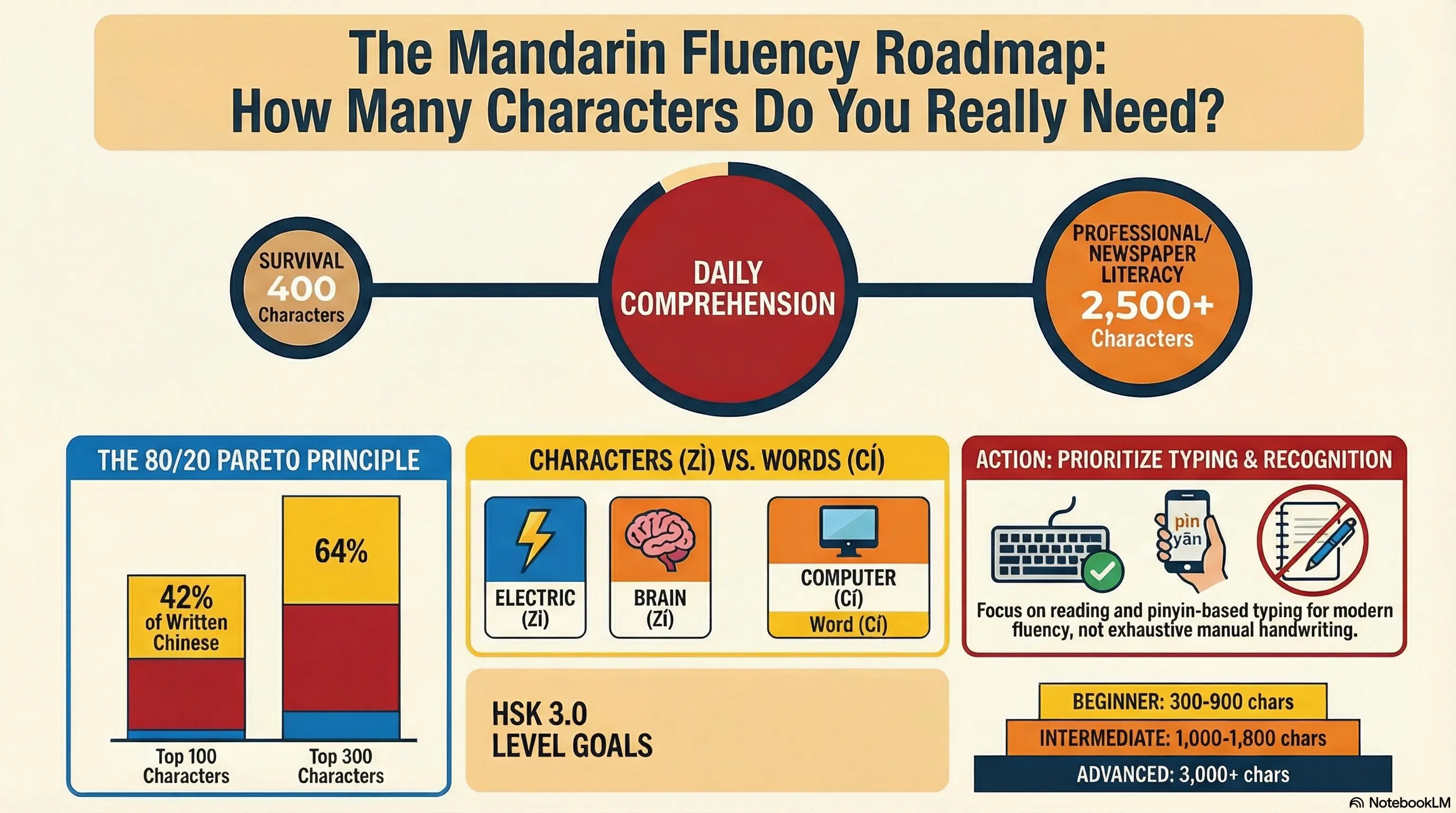
- Survival (400 Characters): You can read signs, find a bathroom, recognize numbers, and basic menus. You are functionally a tourist.
- Daily Life (1,000 Characters): You cover about 90% of written materials. You can text friends, read simple blogs, and get around Chinese cities comfortably.
- Newspaper/Work Fluency (2,500 - 3,000 Characters): You cover 99.2% of general written text. You can read newspapers, novels, and work emails without constantly using a dictionary.
- Native Educated (4,000+ Characters): This is university-level academic literacy.
Key Takeaway: The leap from 90% comprehension (1,000 chars) to 99% comprehension (3,000 chars) takes years of effort.
The HSK Confusion: Characters vs. Words
This is where most students get tripped up. HSK lists often measure Words (词 - Cí), not just unique Characters (字 - Zì).
In Mandarin, most modern words are bisyllabic (made of two characters).
- Character: 电 (Diàn - Electricity)
- Character: 脑 (Nǎo - Brain)
- Word: 电脑 (Diànnǎo - Computer)
If you know the characters for "Electricity," "Vision," and "Brain," you can instantly unlock words like "Television" (Diànshì) and "Computer" (Diànnǎo) without rote memorization.
This concept is essential when looking at New HSK (3.0).
Approximate HSK 3.0 Breakdowns
(Note: Numbers are approximate guidelines as curriculums shift).
- Beginner (HSK 1-3): ~300 to 900 characters.
- Capability: Basic tourism, self-introduction, simple sentences.
- Check HSK 1 Requirements here.
- Intermediate (HSK 4-6): ~1,000 to 1,800 characters.
- Capability: Fluency in communication, reading slides, general work conversation.
- Advanced (HSK 7-9): ~3,000+ characters.
- Capability: Translation, interpretation, academic research.
Reality Check: An "Old HSK 6" certificate (pre-2022) required 5,000 words, but only about 2,663 unique characters. If you know 2,700 characters well, you are technically at the old "exam fluency" cap.
The Pareto Principle: The 80/20 Rule of Mandarin
You do not need to learn characters in alphabetical order (which doesn't exist anyway!). You need frequency order.
The frequency statistics of Chinese are incredibly skewed:
- The top 10 most common characters make up nearly 4% of all Chinese text.
- The top 100 characters make up 42% of all text.
- The top 300 characters make up 64% of all text.
This is a massive advantage for learners. By aggressively mastering the first 500 characters, you achieve statistically high coverage.
Study Strategy: Do not focus on "Dragon" (Lóng) or "Sword" (Jiàn) first unless you are watching specific fantasy dramas. Focus on functional particles and pronouns like 的 (de), 一 (yī), and 是 (shì).
Strategies to Increase Your "Character Count"
How do you move from 300 to 3,000 without burning out?
1. Radicals are Your Best Friend
Don't memorize strokes; memorize components. If you know the Fire Radical (火), you can guess that 烧 (burn), 烤 (roast), and 热 (hot) relate to heat.
- Resource: Read our guide on How to Recognize Chinese Characters by Radicals.
2. Contextual Learning (The Compound Method)
Don't learn characters in isolation. When you learn 学 (Study), learn the whole family:
- 学生 (Student)
- 学校 (School)
- 学习 (To study)
- 数学 (Math - Number study)
3. Reading Graded Readers
To solidify the "Core 1,000," avoid diving straight into Harry Potter (which requires ~3,500 chars). Use "Graded Readers" specifically designed for HSK levels. This ensures repetition of high-frequency characters in context.
- Practice: Start with our HSK Level Reading Materials.
A Note on "Typing Fluency" vs. "Handwriting Fluency"
In 2026, the definition of literacy has evolved. Ask a young Chinese native speaker to write "sneeze" (dǎ pēntì) by hand, and they might hesitate on the characters 喷嚏.
This is called "Character Amnesia" (提笔忘字).
- Recognition: Being able to read the character when you see it (Essential).
- Production (Typing): knowing the Pinyin pēntì and recognizing the character from a list (Essential).
- Production (Writing): Writing stroke-by-stroke from memory (Essential only for HSK Paper exams).
If your goal is business fluency, prioritizing Reading Recognition and Typing is a valid strategy. Don't let the inability to handwrite 3,000 characters stop you from speaking.
Setting Your Personal Fluency Goals
Don't obsess over the number 5,000. Set functional goals:
- Travel Goal: ~500 Characters (HSK 2-3 range).
- Social Goal: ~1,000 Characters + good Listening/Speaking.
- Professional Goal: ~2,500 Characters + industry specific vocabulary.
Conclusion
The number of Chinese characters needed for fluency depends entirely on what you want to be fluent in. To chat with friends and survive in China? 1,000 characters is your milestone. To study at a University? 3,000 characters is the goal.
Language learning is a marathon. Start with the most frequent characters, master the HSK vocab words, and celebrate every new symbol you unlock.
Ready to start? Begin by ensuring you know How to Write Chinese Characters correctly to build strong foundations, or check out our full HSK Overview to map your path.
加油 (Jiāyóu) – Keep going!